
Europe is not the easiest pet market to enter, but it remains one of the most important markets to understand. The latest FEDIAF data shows a mature region with more than 306 million pets, high household penetration, a large pet food industry, and increasingly demanding rules around nutrition, labeling, sustainability, and product responsibility.
A Chinese industry summary of the FEDIAF 2026 Facts & Figures highlighted the same point: Europe is no longer a simple volume-growth story. It is a market where pet ownership is broad, but growth depends on product quality, category fit, compliance, and the ability to serve different country-level preferences.
The Headline Number Is Big, but the Market Is Mature
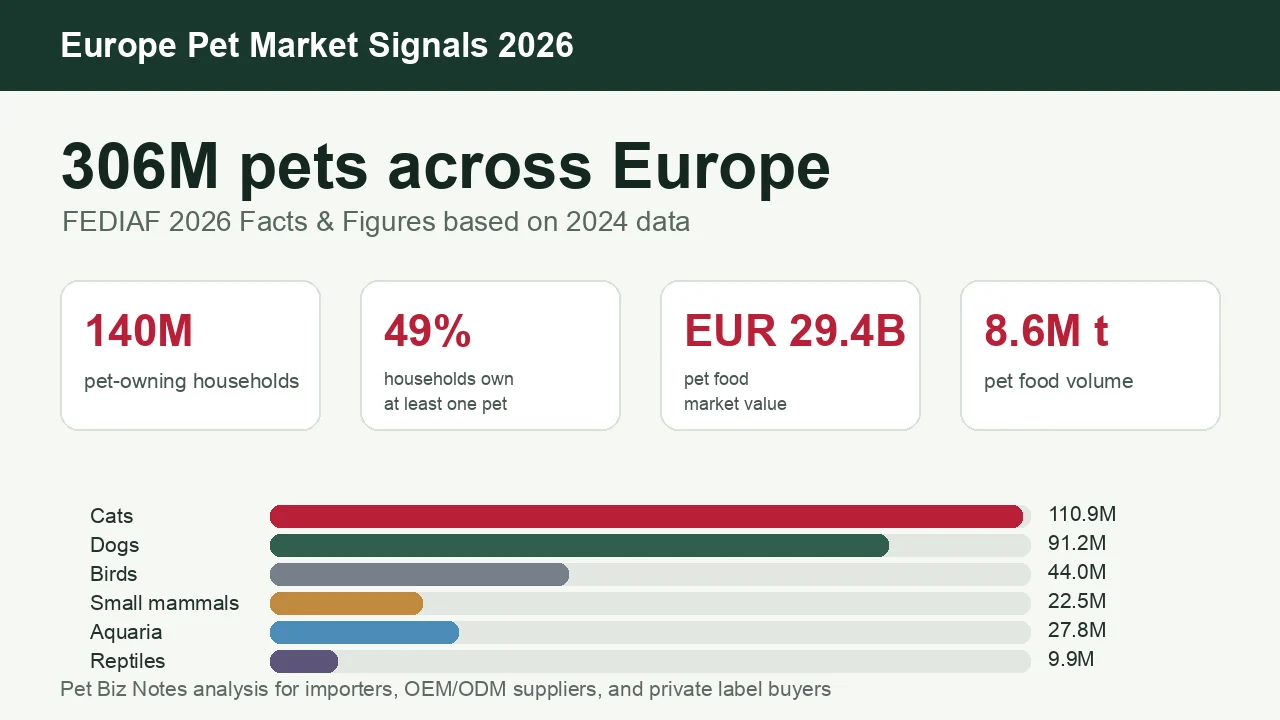
FEDIAF says its 2026 report confirms 140 million European households owning one or more pets, equal to 49% household penetration. The same FEDIAF statistics page also reports annual pet food sales of EUR 29.4 billion and a volume of about 8.6 million tonnes.
The Chinese summary, based on the FEDIAF report, puts the total European pet population at about 306.15 million, including cats, dogs, birds, small mammals, aquaria, and reptiles. Excluding aquaria, the figure is about 278.41 million. This is not a small market, but the more important point is that Europe is already a developed pet economy.
For suppliers, that means the market should not be approached with a simple “more pets means more orders” logic. Europe already has strong local brands, mature retailers, established pet food manufacturers, strict label expectations, and consumers who compare quality carefully. Growth is possible, but weak products have fewer hiding places.
Cat Economics Are Becoming More Important
One of the clearest signals is the strength of cat ownership. The FEDIAF-based summary lists about 110.86 million cats in Europe, compared with about 91.21 million dogs. This difference matters because cats often fit urban apartments, single-person households, and smaller living spaces more easily than dogs.
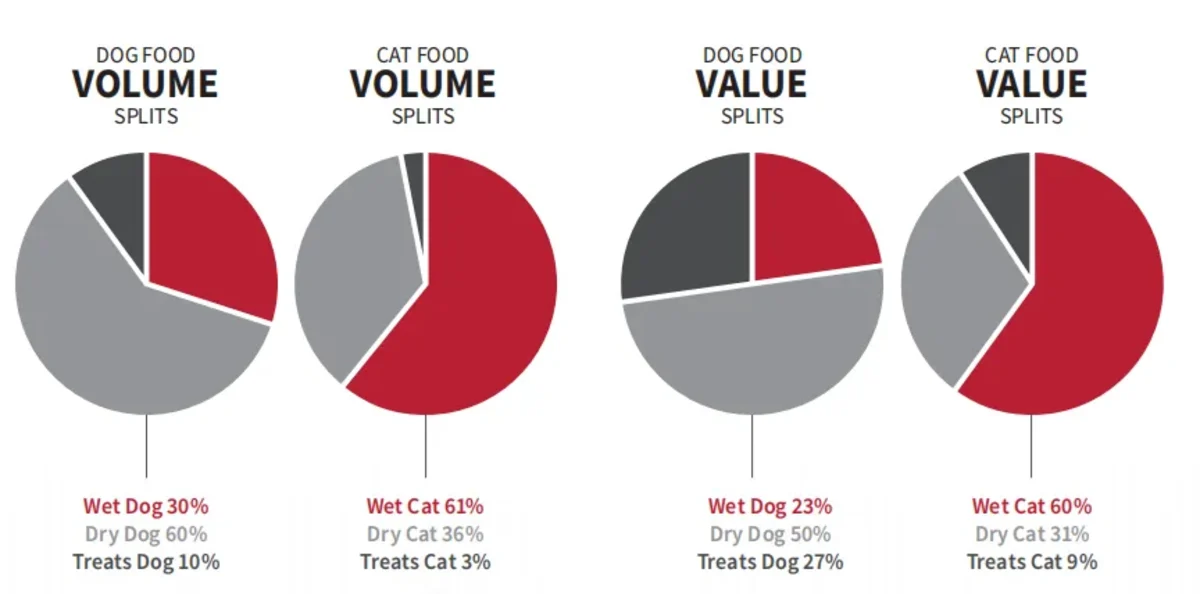
More important, cat food can be a higher-value category. The source summary states that dog food accounts for 58% of production volume and cat food for 41%, but by market value cat food contributes 50% while dog food contributes 46%. That means the cat food category is not only large; it is also more value-dense.
For private label buyers and OEM suppliers, this points to a practical direction: do not treat cat products as a secondary line after dog products. Cat wet food, functional cat food, hairball support, urinary care positioning, digestion support, senior cat formulas, and texture/palatability work can all become serious planning areas.
Wet Cat Food Is Not a Minor Detail
The split between dry and wet products is another important lesson. In the source chart, dog food volume is led by dry food, while cat food volume is led by wet food. Cat wet food accounts for 61% of cat food volume and 60% of cat food value, while cat dry food is smaller.
This matters because wet food is a different supply-chain problem from dry kibble. It requires different packaging, shelf-life control, palatability testing, processing discipline, claims management, and channel planning. A buyer that is strong in dry food should not assume it can enter European wet cat food with the same supplier checklist.
For factories and brand owners, the strategic question is not “Can we make cat food?” It is more specific: can we make a cat product that fits European feeding habits, explains its value, passes label and nutrition expectations, and reaches the right channel without becoming too expensive?
Europe Rewards Premiumization, but Not Empty Premium Claims
The report summary describes Europe as a market where value growth is stronger than pure volume growth. This is consistent with the broader picture: mature pet markets often grow through better products, better claims, better packaging, and more specialized nutrition, not just more tonnes of product.
That does not mean every “premium” product will work. European buyers and regulators are sensitive to claims, ingredient transparency, sustainability language, and labeling details. A product positioned around grain-free, organic, weight management, functional treats, or sensitive digestion needs a clear technical and regulatory basis.
This connects directly with an earlier Pet Biz Notes point: pet food growth is increasingly about supplier capability. A low-cost quotation is not enough if the target market expects strong documentation, stable production, and careful label support.
Country Differences Matter More Than a Single “Europe” Strategy
The FEDIAF-based summary also shows strong country differences. The UK, France, Italy, Germany, and Turkey are among the largest pet-population markets depending on whether aquaria are included. France leads in cat population, the UK leads in dog population in the source summary, Italy and Turkey stand out for ornamental birds, and the UK is unusually strong in aquaria.
That means “Europe” should not be treated as one uniform buyer persona. A product line for German specialty retail may not match a UK e-commerce seller. A cat-focused French opportunity may look different from a dog-focused Polish opportunity. Southern Europe may have different bird or small-pet opportunities from Northern Europe.
For new buyers, this is where category discipline matters. I would not recommend starting with a wide catalog. A stronger path is to choose one country cluster, one species focus, one channel, and a small number of SKUs that can be explained clearly. This is the same logic behind treating MOQ as a market test, not as a display of ambition.
Compliance and Sustainability Are Becoming Entry Conditions
Another key signal in the source article is that European regulation and sustainability expectations are moving from marketing language to operating requirements. Pet food environmental footprint discussions, recyclable packaging, animal by-product rules, label discipline, and nutrition standards all affect supplier selection.
This should change how export suppliers prepare for Europe. Buyers will care about product samples, but they will also care about ingredient documentation, label support, packaging material, batch consistency, test reports, and how claims are written. The supplier who can help reduce compliance risk has a stronger role than the supplier who only ships product.
For packaging, the same principle applies. The label must do more than look attractive. It must support the product’s positioning and channel requirements. I covered this in more detail in the Pet Biz Notes article on private label pet food packaging strategy.
Where Xinji Can Fit
For overseas buyers studying Europe or Europe-adjacent markets, the useful supplier is not only a factory that can make pet food. It is a partner that can help think through species focus, formula direction, product form, pack size, test orders, claims, and reorder logic. Xinji Pet Food can support OEM/ODM pet food and pet health product projects where buyers need product planning, manufacturing, packaging discussion, and export coordination.
The European market also offers lessons for Southeast Asia, Latin America, and other growing regions. Mature markets show where the category is heading: more cat-focused products, stronger wet-food demand in some channels, higher expectations for nutrition and safety, and less tolerance for vague premium claims.
Ian’s Take
Europe’s 306 million pets are important, but the real message is not just scale. The market is mature, segmented, and rule-driven. It rewards suppliers who understand product fit, not suppliers who only chase large population numbers.
For pet food exporters and private label buyers, the next question should be practical: which species, which country cluster, which product form, which claim, and which channel can we serve better than a generic supplier?
If that answer is clear, Europe can still be attractive. If the answer is vague, the market’s size may create more mistakes than orders.