
Many private label pet product projects do not fail because the idea is bad. They fail because the first order is planned badly. Too many SKUs, too many package sizes, unclear MOQ expectations, slow-moving inventory, and weak reorder logic can turn a promising pet food or supplement idea into a cash-flow problem.
Ian Guo’s view is that MOQ should not be treated only as a factory requirement. MOQ is also a business test. A smart first order should help the buyer learn which product, formula, package, channel, and price point can generate repeat demand before the buyer expands too aggressively.
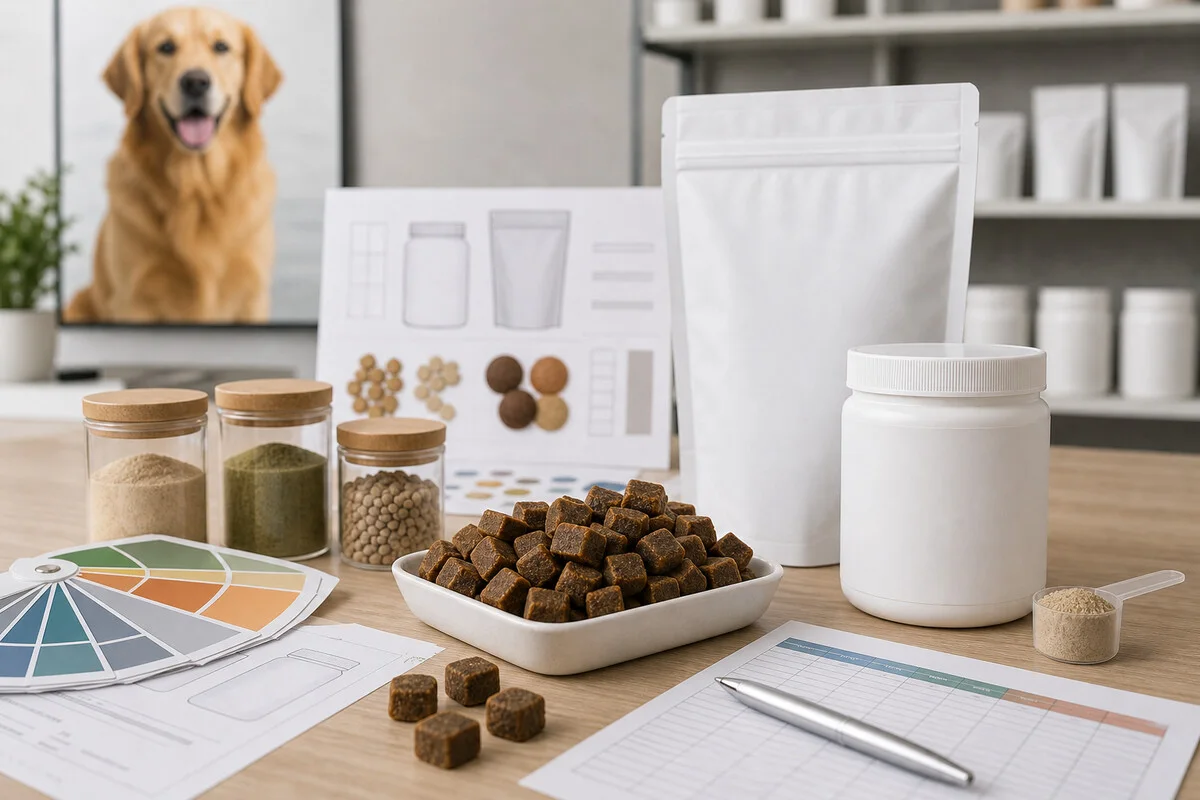
MOQ is not only a number from the factory
Buyers often ask, “What is your MOQ?” That is a reasonable question, but it is incomplete. The better question is: “What first-order plan gives me enough product to test the market without creating unnecessary inventory risk?”
For pet food, MOQ depends on formula, ingredient availability, production line setup, packaging material, label printing, carton planning, and export shipment. For supplements, soft chews, nutritional paste, treats, bottles, jars, and pouches, MOQ may also be affected by packaging components, flavor direction, active ingredient sourcing, and stability requirements.
This is why the lowest MOQ is not always the best answer. If the factory reduces MOQ too far, unit cost may rise, packaging options may narrow, or production efficiency may suffer. If the MOQ is too high, the buyer may be forced into inventory before the market is tested. The real goal is balance.
The first mistake: launching too many SKUs
A new private label buyer may want to launch dog food, cat food, treats, probiotics, joint support, skin and coat, urinary wellness, oral care, and senior pet products at the same time. The logic sounds attractive: a bigger catalogue looks more complete. In practice, too many SKUs can make the first order harder to sell, harder to explain, harder to forecast, and harder to reorder.
Each SKU needs formula discussion, packaging, label wording, carton planning, shelf space, online content, customer education, and sales follow-up. If the buyer does not yet know which product will sell fastest, launching too many products can spread attention and cash too thin.
A better route is to start with a focused first line. For example, one dry dog food plus one dry cat food, or one functional treat plus one supplement, or one hero product with one related add-on. The first line should be simple enough for the buyer’s channel to understand and strong enough to create repeat purchase.
The second mistake: confusing sample approval with market approval
Sample approval is only the beginning. A buyer may like the sample’s smell, texture, package, and price, but the market still needs to respond. Distributors may ask for another price band. Pet shops may prefer a different bag size. Online customers may need clearer usage explanation. Veterinarians or professional channels may require more careful claim language.
Before scaling up, buyers should treat the first order as a structured test. Which SKU moves fastest? Which package size gets reordered? Which claim language creates questions? Which channel sells the product with less discounting? Which product creates repeat purchase rather than one-time curiosity?
This connects with our article on choosing pet product categories without chasing every trend. A category may be attractive, but the buyer still needs a first-order structure that can prove demand in the real channel.
How to plan a safer first order
A safer first order starts from the market route, not from the factory catalogue. The buyer should define the target customer, target channel, price level, product promise, and reorder goal before deciding SKU count and quantity.
- For distributors: choose products that are easy to explain, stable in price, and suitable for repeat wholesale orders.
- For pet shops: choose pack sizes that fit shelf space, daily customer needs, and visible product differences.
- For e-commerce: choose products that photograph well, have a clear use case, and can be bundled with related items.
- For shelters or bulk buyers: choose simple packaging, stable supply, and cost control over heavy retail decoration.
- For investors planning a future factory: use OEM production first to test which formulas and package formats deserve local production later.
The goal is not to make the first order small for its own sake. The goal is to make the first order informative. It should create enough market evidence to guide the second order.
Packaging MOQ can become the hidden constraint
Sometimes the production MOQ is not the real issue. Packaging MOQ is. Printed bags, labels, cartons, bottles, jars, pouches, and special closures can all create minimum quantities. A buyer may think the product MOQ is manageable, then discover that packaging inventory is the bigger commitment.
This is why packaging strategy should be discussed early. In our article on pet food packaging as a business decision, the key point was that packaging affects cost, shelf life, channel fit, logistics, and reorder behavior. It also affects MOQ.
For a first order, buyers may consider plain packaging, sticker labels, shared packaging structures, or limited printed designs before investing in a full packaging system. This is especially useful when the buyer is still testing formula, pack size, and channel response.
Inventory risk is not only financial
Slow inventory ties up cash, but the risk is broader than money. It can reduce attention, occupy warehouse space, create discount pressure, and make the sales team focus on clearing old stock instead of learning the market. For pet food and supplements, shelf life also matters. A slow product becomes harder to sell as the remaining shelf life shortens.
That is why first-order planning should include a sell-through assumption. How many units can the buyer realistically move in the first 30, 60, and 90 days? Which channel will carry the product? What reorder signal will be used? What discount plan exists if one SKU performs slower than expected?
A buyer does not need perfect forecasting. But the buyer does need a clear test plan.
A practical first-order checklist
Before confirming MOQ and SKU count, buyers can use this checklist.
- Hero product: Which SKU explains the brand or category best?
- Support SKU: Is there one related product that increases basket size without confusing the buyer?
- Pack size: Is the first pack size designed for trial, daily use, value purchase, or wholesale supply?
- Channel: Which channel will sell the first order first, and who will educate the customer?
- Packaging: Is packaging MOQ aligned with product MOQ and launch budget?
- Reorder trigger: What sales result will justify the second order?
- Exit plan: What happens if one SKU sells slower than expected?
Where Xinji can help buyers plan MOQ and launch sequence
Xinji Pet Food’s OEM and ODM service is relevant because MOQ planning should be connected with formula, packaging, production route, export logistics, and market entry. A buyer who only asks for the minimum quantity may miss the larger question: what first-order structure makes the business easier to validate?
For dog food, cat food, treats, soft chews, nutritional paste, and pet supplement lines, Xinji can help buyers compare product direction, packaging options, first-order quantity, private label route, and phased expansion. This is part of the broader shift discussed in Chinese pet food factories moving beyond OEM: experienced manufacturers can support business planning, not only production.
Ian Guo’s conclusion
MOQ should not be negotiated blindly. It should be planned around learning. A good first order gives the buyer enough product to test the market, enough focus to sell clearly, and enough flexibility to adjust the second order.
For private label pet product buyers, the smartest launch is often not the biggest launch. It is the launch that proves which SKU deserves more investment.
In my view, the second order is more important than the first. The first order tests the idea. The second order proves whether the business is beginning to work.