
A pet food OEM factory should not be evaluated only by price, sample appearance, or whether the sales team replies quickly. Those things matter, but they do not prove that the factory can control raw materials, production stability, labeling, packaging, shipment quality, and repeat-order consistency.
Ian Guo’s view is simple: a reliable pet food manufacturer is not the factory that sends the lowest quotation. It is the factory that reduces long-term risk for the buyer. For importers, distributors, private label brands, e-commerce sellers, and investors planning pet food projects, quality control should be checked before production, not after the container has already arrived.
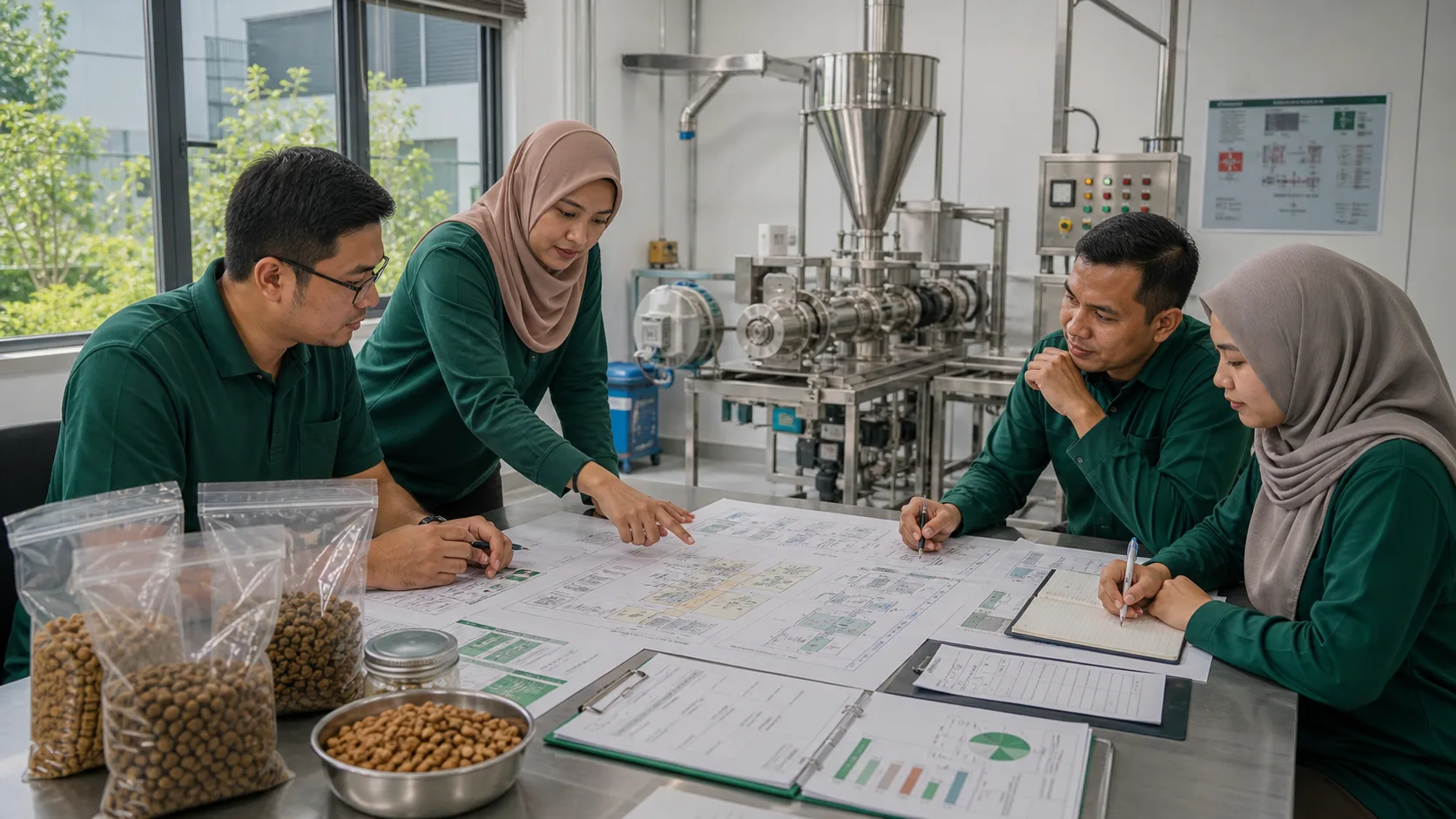
Start with the factory’s quality system, not only the product sample
A sample can look good and still fail at scale. The real question is whether the factory can repeatedly produce the same quality across batches. Buyers should ask how the factory controls raw material receiving, formula management, mixing, extrusion or processing, drying, coating, packaging, storage, and shipment.
This is also why international regulatory thinking is useful even when the target market is not the United States or the European Union. The FDA’s FSMA animal food information explains the importance of current good manufacturing practice and preventive controls for animal food. AAFCO’s consumer guidance on pet food also notes that pet food regulation in the United States involves both FDA and state-level feed control systems, while AAFCO provides model language that many states may use. In the EU, Regulation (EC) No. 183/2005 sets requirements for feed hygiene.
For buyers, the practical lesson is not to memorize every regulation. The lesson is that serious pet food production is built around prevention, documentation, hygiene, ingredient control, and traceability. A factory that cannot explain those basics clearly is not ready for serious private label or export work.
Raw material control is the first quality checkpoint
Many quality problems begin before production. A pet food formula may list chicken meal, fish meal, rice, corn, pea, oil, vitamins, minerals, palatability materials, probiotics, prebiotics, or functional ingredients, but the final product depends on real supplier control.
Before OEM production, buyers should ask how raw materials are approved, how incoming materials are checked, how nonconforming materials are handled, and whether each batch can be linked back to supplier records. For premium or functional pet food, this becomes even more important because small formula changes can affect palatability, texture, cost, and claim language.
A factory does not need to reveal every supplier name to every buyer. But it should be able to explain the control logic: specification, receiving inspection, storage conditions, batch recording, supplier review, and what happens if a material does not meet requirements.
Formula stability must be managed batch by batch
In private label pet food, a buyer may approve one sample and assume future production will match it. That assumption is risky. Formula stability requires controlled recipes, clear production instructions, weighing accuracy, mixing consistency, moisture control, process parameters, and final product checks.
For dry kibble, buyers should pay attention to particle size, density, moisture, coating uniformity, aroma, palatability, breakage, and package performance. For soft chews, nutritional paste, treats, or supplements, the checks may be different: texture, fill weight, viscosity, chew hardness, active ingredient handling, sealing, shelf-life direction, and storage stability.
This connects with our earlier observation on pet supplement claims risk. If the product carries functional language, the factory and buyer must be more disciplined about formula consistency, ingredient evidence, and wording boundaries.
Production records are part of the product
Some buyers only ask for finished goods photos. That is not enough. A serious factory should be able to maintain production records that show what was made, when it was made, which materials were used, which batch number was assigned, which checks were completed, and which staff or process steps were involved.
For export buyers, this matters because problems may appear weeks or months after shipment. If a customer complains about odor, broken kibble, swelling bags, incorrect labels, or inconsistent color, the buyer needs batch-level traceability. Without records, every problem becomes a guessing game.
Good records do not make a factory perfect. They make the factory accountable. They also help the buyer understand whether an issue is related to formula, raw material, production process, packaging, storage, shipping, or local handling.
Packaging quality is not decoration
Packaging is often discussed too late. Buyers may spend time on design but not enough time on packaging structure, sealing, oxygen and moisture control, carton strength, pallet loading, label accuracy, and export handling.
For pet food, packaging is part of quality control. A good formula can still fail if the bag leaks, seal strength is weak, the label is incorrect, the barcode does not scan, the carton collapses, or the retail pack does not survive shipping and warehousing.
Before production, buyers should confirm package size, bag material, sealing method, date coding, batch coding, carton layout, pallet method, and whether the packaging is appropriate for the product’s oil level, moisture level, and expected shelf life.
Remote factory checks: what buyers can ask before visiting
Not every buyer can visit the factory before the first order. Remote evaluation is not perfect, but it can still be useful if the buyer asks practical questions instead of only requesting a catalogue.
- Can the factory explain the production flow for the exact product type?
- How are raw materials approved, received, stored, and traced?
- What checks are performed during production and before shipment?
- How are batch numbers, production records, and retained samples managed?
- How are labels, package language, date codes, and carton marks checked?
- What happens if a finished batch does not meet specification?
- Can the factory support product-line planning instead of quoting only one SKU?
The answers will show whether the supplier thinks like a manufacturer or only like a trading desk.
Factory capability matters more in Southeast Asia projects
For buyers in Vietnam, Indonesia, the Philippines, Thailand, and other Southeast Asian markets, factory quality is connected with market entry. A distributor may start with imported OEM pet food, then later consider local repacking or local production. An e-commerce seller may test supplements first, then add dry food and treats. An investor may want to build a local pet food factory, but still needs to understand formula, equipment, raw materials, and quality systems before buying machinery.
This is why the factory’s experience matters. A supplier that has seen many product launches can help buyers avoid common mistakes: too many SKUs, wrong package size, unstable raw materials, unclear claim language, weak carton planning, unrealistic equipment investment, or a product line that does not match the channel.
Our article on China pet food factories moving beyond OEM explains the same direction from a broader business angle. Quality control is one part of that full-chain support. Production experience, sales logic, equipment planning, and quality systems should work together.
Where Xinji fits in this discussion
Xinji Pet Food is relevant because its value is not limited to making private label pet food or pet supplements. For buyers who are new to the category, the more important support may be product planning, formula discussion, supply-chain organization, packaging choice, production route, and practical launch guidance.
For a buyer comparing pet food OEM factories, the useful question is not only “Can you produce this product?” It is also “Can you help me reduce mistakes before production starts?” Xinji’s experience in pet food manufacturing and export supply can help buyers think through the route from product idea to factory execution and market launch.
That is especially important for buyers who want to start with OEM production first and later consider local manufacturing. The first supplier should help build a better learning curve, not only complete a one-time order.
Ian Guo’s conclusion
A reliable pet food factory is not defined by one sample, one low quote, or one polished brochure. It is defined by whether the factory can control the whole process: materials, formula, production, testing, packaging, records, shipment, and problem response.
For buyers, the best time to check quality control is before the order. Ask direct questions. Request evidence. Understand the production flow. Confirm how batches are traced. Make sure packaging and labels are controlled. Treat quality as a business system, not a final inspection.
In my view, this is where serious OEM factories will separate from ordinary suppliers. The future buyer does not only need a factory that can make pet food. The buyer needs a factory that can help build a stable, repeatable, and lower-risk pet food business.