
AI in the pet industry is not only about chatbots, product descriptions, or smart cameras. A more important change is beginning inside the product system itself: formula design, ingredient selection, production planning, quality control, packaging, and traceability.
Recent industry discussion around “Pet Food 4.0” points in this direction. The idea is simple but important: pet food manufacturing is moving from experience-led decisions toward data-assisted decisions. For pet food brands and OEM/ODM factories, this may become one of the biggest operational changes of the next few years.
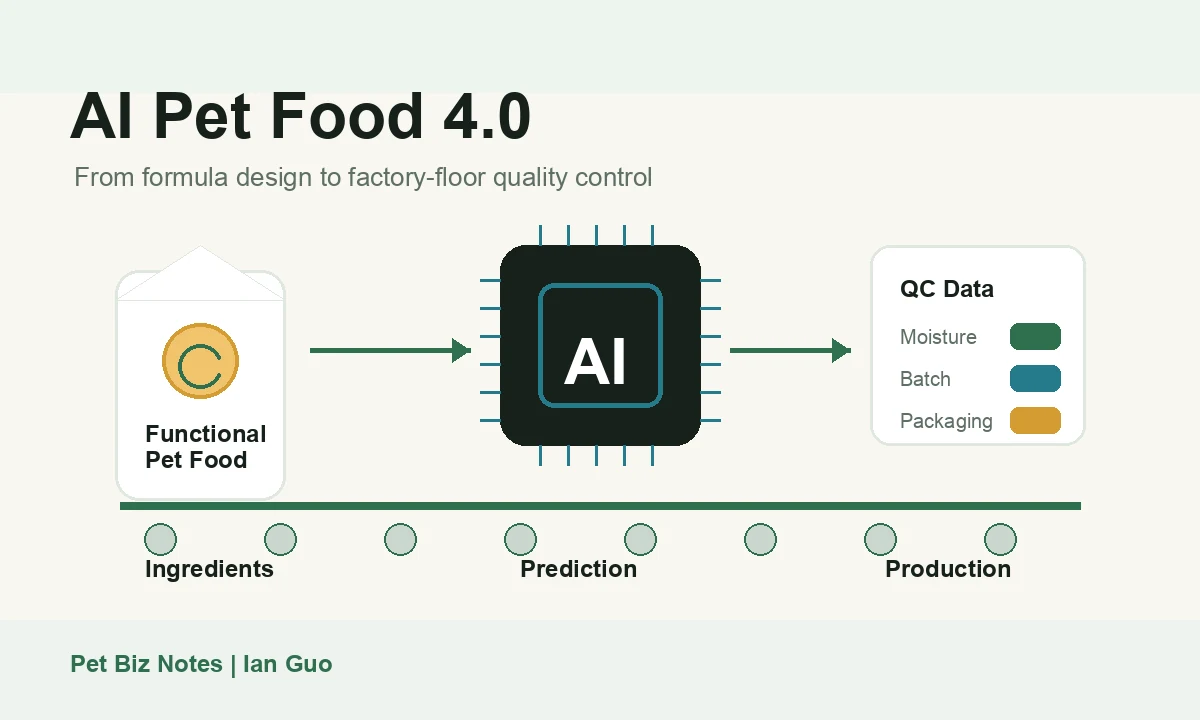
From my point of view, the most important question is not whether a pet food company says it uses AI. The real question is where AI enters the workflow and whether it improves a decision that already matters.
AI will first help with decisions that are already difficult
Pet food is a difficult category because every decision connects to another decision. A formula is not only a nutrition idea. It is also an ingredient cost structure, a supply-chain risk, a production process, a palatability target, a shelf-life requirement, a packaging format, and a regulatory statement.
This is exactly where AI can become useful. It can compare more variables than a person can easily hold in mind. It can help teams test formula directions, evaluate ingredient substitutions, detect production anomalies, and connect quality data with batch history.
But AI will not remove the need for professional judgment. In pet food, the final decision still needs nutrition knowledge, manufacturing experience, market understanding, compliance review, and common sense. The best use of AI is not to replace the product team. It is to give the product team a better decision system.
Formula design may become more data-driven
For many brands, formula development still begins with a market idea: grain-free, high-protein, sensitive stomach, hairball control, skin and coat, senior support, or breed-specific nutrition. These ideas are familiar, but turning them into a manufacturable formula is not simple.
AI can help product teams compare ingredients, nutrient targets, cost ranges, supply stability, and possible claims. It can also help identify gaps between a marketing concept and the real formula behind it.
This matters because pet food competition is moving away from generic positioning. “Premium” is no longer enough. “Natural” is no longer enough. Brands need clearer product logic: why this formula exists, which pet problem it addresses, what evidence supports the claim, and how it differs from similar products.
For OEM/ODM factories, this creates an opportunity. A factory that can discuss formula logic, ingredient trade-offs, palatability risk, production feasibility, and testing plans will be more valuable than a factory that only provides a price list.
Quality control is where AI may create immediate value
The faster commercial value may not come from new formulas. It may come from quality control.
Pet food production has many points where small changes matter: moisture, temperature, extrusion conditions, drying, coating, packaging seal quality, foreign material control, batch consistency, and storage conditions. A human quality team can monitor these factors, but AI-assisted systems can help detect patterns earlier.
For example, if a factory records batch data over time, AI can help identify which production conditions correlate with higher rejection rates, texture variation, moisture drift, or shelf-life risk. This does not require a futuristic factory. It requires disciplined data collection and a willingness to connect quality records with production reality.
This is where many factories will face a practical gap. They may want to talk about AI, but their data may still be scattered across paper forms, separate spreadsheets, machine logs, and manual inspection notes. Before AI can be useful, the factory needs clean operational data.
Personalized nutrition will grow, but not as fast as marketing claims suggest
Personalized pet nutrition is one of the most attractive AI stories. In theory, a brand can build a feeding plan around breed, age, weight, activity level, health history, stool condition, allergy signals, and owner preference.
In reality, personalized nutrition is difficult to execute at scale. It touches formulation, manufacturing flexibility, packaging, logistics, data privacy, customer education, and recurring service operations. It is not just an algorithm problem.
My view is that personalization will first appear in lighter forms: recommendation systems, feeding calculators, condition-based product selection, customized bundles, and subscription plans. Fully individualized formulas will exist, but they will be more complex and more expensive to operate.
For manufacturers, the important preparation is not to chase the word “personalized.” It is to build modular product systems. If a factory can support clear base formulas, functional add-ons, flexible packaging, and reliable small-batch management, it will be better positioned for the next stage.
Packaging and traceability will become part of the AI story
Pet food buyers are also asking more questions about packaging, sustainability, freshness, and product safety. AI can support these questions when packaging data, batch data, and product information are connected.
For example, a QR code on packaging can become more than a marketing link. It can connect owners to feeding instructions, batch information, freshness guidance, recycling information, ingredient explanations, and customer support. Over time, those interactions can give brands better feedback about product use.
This is important for exporters. International buyers increasingly want products that are easy to explain, easy to verify, and easy to support after sale. Packaging is no longer only a design surface. It is becoming a data interface.
What this means for pet food OEM/ODM factories
For factories, AI Pet Food 4.0 should not be treated as a slogan. It should be treated as an operational upgrade path.
- Build better data discipline. Production, QC, raw material, and complaint data should be structured enough to analyze.
- Improve formula communication. Buyers will expect clearer explanations of ingredient choices, nutrition targets, and functional positioning.
- Prepare for traceability questions. Batch records, supplier control, and packaging information will become more important.
- Connect R&D with production reality. A formula that looks good in a presentation still has to run reliably on the line.
- Use AI where it improves a real decision. Do not add AI language to marketing before the operation can support it.
The factories that benefit will not necessarily be the largest ones. They will be the ones that can combine manufacturing reliability with better data, clearer documentation, and more professional product thinking.
What this means for pet food brands
For brands, AI will raise the standard for product claims. If a brand says a product supports digestion, skin health, senior mobility, dental care, or weight control, buyers will increasingly expect a clearer explanation of why.
This does not mean every brand needs to become a medical company. But it does mean weak product stories will become easier to expose. AI search, AI recommendation tools, and better consumer education will make vague claims less effective.
Brands should prepare product pages, packaging, FAQs, and sales materials with more structure. Ingredients, use cases, feeding logic, target pets, manufacturing standards, and test information should be easy for humans and AI systems to understand.
My expectation
I do not think AI will immediately transform every pet food factory. The industry is too physical, too regulated, and too dependent on manufacturing details for that to happen overnight.
But I do think AI will gradually change the competitive standard. Buyers will ask better questions. Brands will need stronger evidence. Factories will need better traceability. Product managers will use data more often. Quality teams will move from inspection-only thinking toward prediction and prevention.
That is the real opportunity of AI Pet Food 4.0. It is not about making pet food sound more advanced. It is about making pet food development and manufacturing more disciplined.
For pet food companies, the best starting point is simple: identify the decisions that are already expensive, slow, or inconsistent. Then ask whether AI and better data can make those decisions clearer.
That is where the real value will appear.